
Will My Mask Really Work With Any Machine?
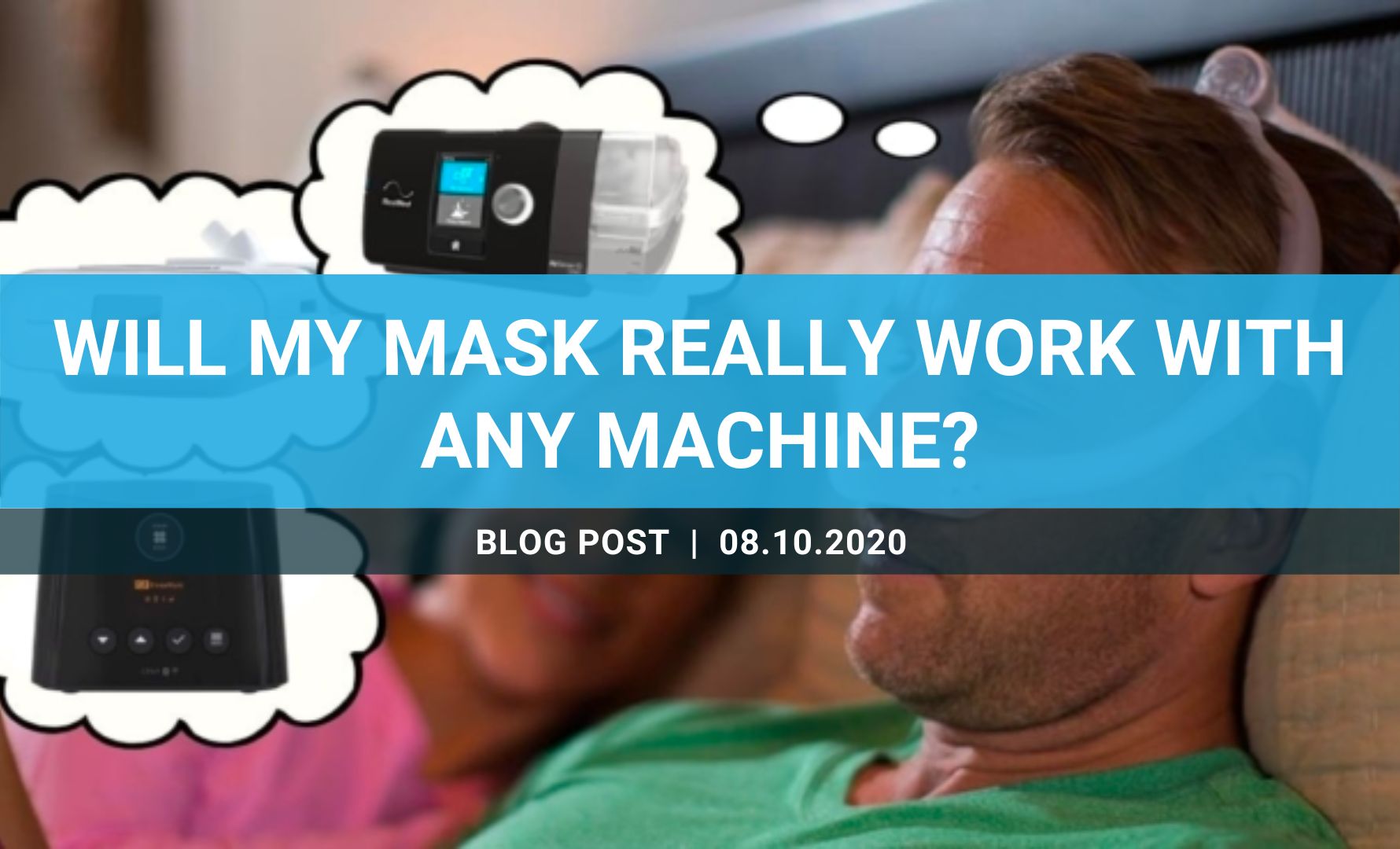
You may have heard that CPAP masks are universally compatible across machines. Yes, it’s true! You really can use any CPAP mask with any CPAP or BiPAP machine, with one exception.
It’s common to think you need a certain kind of mask to fit your machine – but why is that? There are a few different issues that arise and leave people confused on mask compatibility. We’ll go through all the ways you might have found yourself thinking masks are not universal, and the one scenario where you will need different supplies than usual.
Key takeaways
- Almost any CPAP mask works with almost any CPAP or BiPAP machine — with one exception.
- Most “won’t connect” problems are a leftover elbow or short tube stuck in the tubing, not real incompatibility.
- Oxygen adapters fit all masks and standard tubing, but heated tubing may need a specific style.
- ResMed’s travel-sized AirMini is the one machine that doesn’t use universal connections.
Ways mask connections can be confusing
1 Elbows are part of the mask, but can get stuck in tubes
Elbow connectors are the L-shaped connector for full-face mask designs. They often have easy release options that leave part of the mask inside the tube, so it’s easy to think a new mask won’t fit. What is really happening is that part of the mask is still in the tube. If you forget part of the mask in an old tube, or if you get a new mask but there’s still a piece of the old one in the tube, you’ll think your mask and tube don’t connect!
If you lose or break the elbow, you’ll likely need to replace the whole mask. It’s also best to replace your mask and tubing regularly so that they don’t stretch out. Insurance providers cover CPAP tubes and mask frames every 3 months to ensure they have good seals.

Replacement parts
2 Short tubes are part of the mask, not the CPAP tubing
Nasal pillow or nasal cushion masks usually have their own short tube, which is often mistaken as a replacement for the main CPAP tube. However, you’ll find they are much too short and don’t fit onto your CPAP. You’ll need to remove the short tube before inserting a new mask into your tubing.
If you like having the flexible short tube attachment, check out the brand new Evora from Fisher and Paykel.

3 Oxygen adapters work with all masks but not all tubing
Oxygen adapters attach between the mask and tube, and allow folks to bleed oxygen into their CPAP therapy. They are universally compatible with all masks and standard tubing. However, if you have heated tubing, there may be restrictions on what style adapter you need.
ResMed’s AirSense has a special version of their heated tube that has an oxygen port built right in, as well as:
- Auto-titration: Smart algorithm automatically adjusts your therapy pressure as your needs change
- EPR: Expiratory Pressure Relief reduces pressure upon exhale, avoiding high pressure mask leaks
- Humidification: 7 levels of humidity and a heated tube ensures you don’t dry out
4 There is one special exception
ResMed’s AirMini is the one exception that doesn’t use the universal connections that all other CPAP machines have. Because of its unique HumidX system for its nasal mask options, the travel CPAP has special connectors and tubing. Forgoing the universal connections that other CPAPs have allows the AirMini to be as small as it is (just 0.66 lb!), as well as include the following features:
- Powerful and quiet: Auto-titrating machine adjusts to your pressure needs as you sleep
- Control in the palm of your hand: Smartphone app gives you complete control over your CPAP therapy
- Mask included with machine: Choose from the AirFit P10, AirFit N20, AirFit F20, or AirFit F30
Conclusion
That covers the different connections for masks and CPAPs. If you’re having trouble connecting a CPAP mask and tube, make sure you have all parts of the mask. If you have a new mask (with its included connector) and it’s not connecting to your tubing, it may be that your tube is too old or loose. Another common issue is that old elbows or parts of a connector remain in the tube when you try to disconnect the mask, making it impossible to put a new style mask into the tube. If you’re having trouble connecting your mask and tube, check out the video we made to help you!
Still can’t get your mask and tube to connect?
Our respiratory therapists can sort out compatibility, fit and replacements. Book a free CPAP check-up and we’ll help.
Free CPAP check-upFrequently asked questions
Can I use any CPAP mask with any machine?
Yes — you can use almost any CPAP mask with any CPAP or BiPAP machine, with one exception (ResMed’s AirMini). All other machines use universal connections, so masks are interchangeable.
Why won’t my new mask connect to my tube?
Usually a piece of the old mask — like the elbow connector or a short nasal-mask tube — is still stuck inside the tubing, so the new mask seems not to fit. Make sure you have all parts of the mask and that no leftover connector remains in the tube. A tube that’s too old or loose can also be the culprit.
Do oxygen adapters work with every setup?
Oxygen adapters are universally compatible with all masks and standard tubing. If you have heated tubing, though, there may be restrictions on which adapter style you need. ResMed’s AirSense offers a heated tube with an oxygen port built right in.
Which machine is the exception to universal compatibility?
ResMed’s AirMini. Because of its unique HumidX system, the travel-sized CPAP uses special connectors and tubing instead of the universal connections. That trade-off is what lets it weigh just 0.66 lb, and it comes with a choice of AirFit P10, N20, F20 or F30 masks.
Apnée Santé provides this online information for education and communication purposes only and it should not be construed as personal medical advice. Information published here is not intended to replace a consultation with a physician regarding your medical care.

